01
The problem
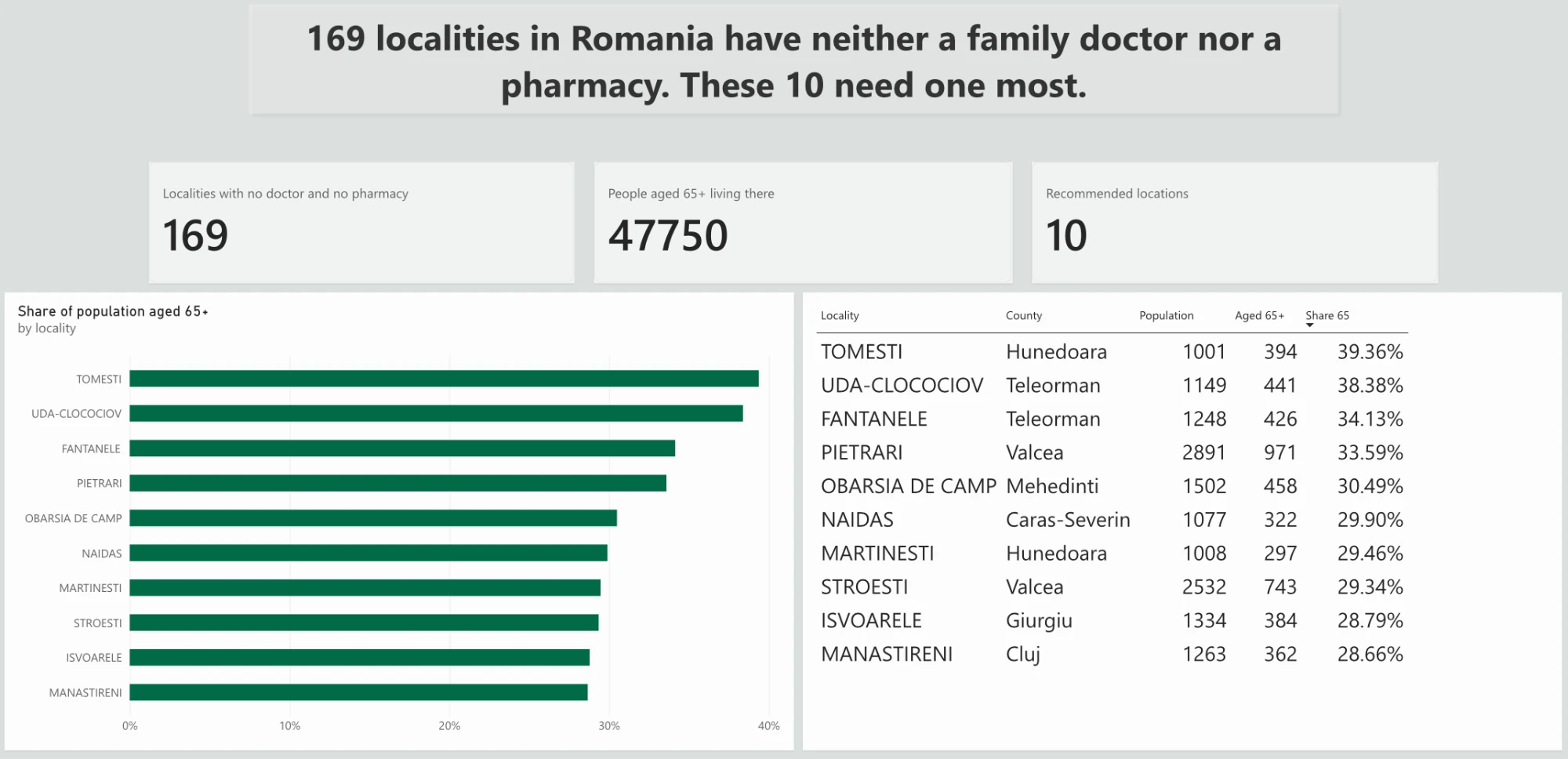
The Ministry of Health has to decide where to open 10 new medical centres. I wanted to find where a large elderly population and missing medical access overlap most strongly — a decision-support question, not just a descriptive one, with a concrete action (a shortlist of localities) attached to the answer.
02
What I did
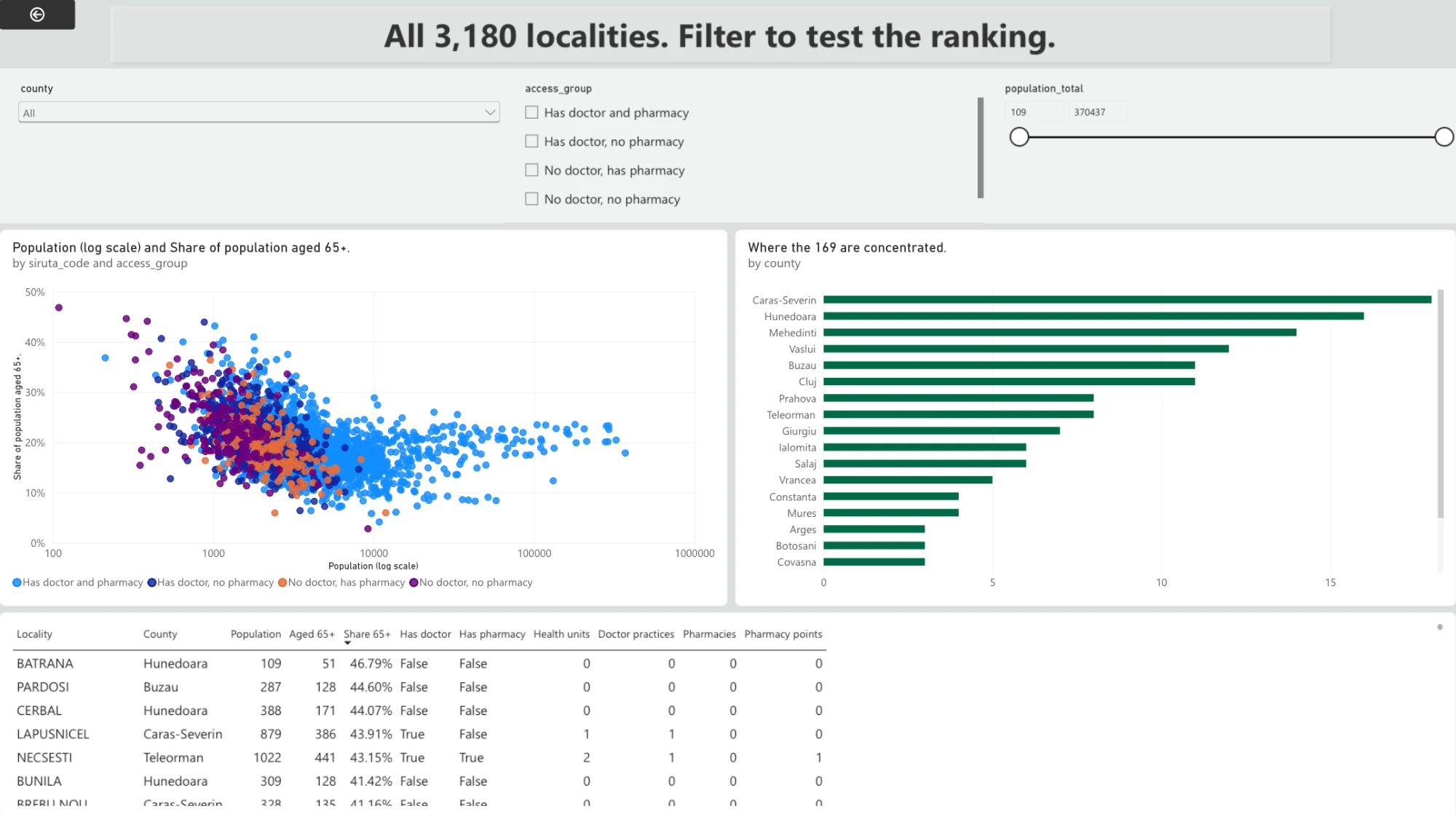
I cleaned and joined two government datasets — population by age group and health-unit counts — across all 3,180 Romanian localities in Python/pandas, using the SIRUTA code rather than locality name as the join key since 239 names repeat across counties. I built two access indicators (has a family doctor, has a pharmacy or pharmacy point) and designed a prioritization rule — a 1,000-inhabitant threshold plus a 2-per-county cap — chosen by testing where the trade-off curve actually bends, not by convention. Every figure was cross-validated independently with raw awk commands against the source CSVs, and I built a two-page Power BI dashboard: one page states the recommendation with no filters, the other lets a skeptical reader challenge the ranking themselves.
03
What I found
169 localities have neither a family doctor nor a pharmacy — and missing a pharmacy turned out to be nearly twice as common as missing a doctor, which a doctor-only indicator would have missed entirely. The final shortlist of 10 localities spans 7 counties and serves 4,798 people aged 65+, each with an elderly share above the national average — a very different list from simply ranking by population size.
04
Trade-offs and what's next
The population figures are registered residence, not actual residents — Romania's rural communes have heavy emigration, so every per-capita indicator here has an inflated denominator precisely where it matters most, and I state that limitation directly rather than let the numbers imply more precision than they have. The distance-to-hospital criterion from the original question is deliberately deferred: it needs geographic coordinates the source data doesn't carry, and I didn't want to bolt on a shaky geocode just to check a box. I also caught a real trap in the raw health-unit data — one county's export coded 'no data' and 'zero units' the same way, which would have silently declared it the best-served county in the country if I hadn't checked row-by-row.